
Nassau Crime News Sources
The Nassau County Sheriff's Office News and Investigations page and its news-release archive are the first stops. Both publish selected, dated events rather than a daily ledger of bookings. A release sent to media, a Crime Stoppers bulletin, or a post carrying an agency-supplied incident or suspect image all fall under NCSO's public information work. Coverage is event-driven, so gaps are normal.
Facebook plays a role too. NCSO posts selected incident releases on its official pages, along with recurring features like Wanted Wednesday. Social posts get edited, corrected, or deleted, so save the agency URL and publication date if you're following a report. A post is publicity, not a booking feed.
Municipal coverage varies. Fernandina Beach police incidents do reach the press, while Hilliard and Callahan depend on NCSO for law enforcement. None of the three incorporated towns runs a verified public daily arrest log. The county's current-custody roster is not a news feed either. It drops people after release, so a date-filtered view can never account for everyone arrested that day.
Start with the agency named in the story. Keep its release date and the exact charge language. Then move from publicity to the official custody and court records, where a later correction or court event carries more weight than an old headline.
Nassau Arrest Coverage Compared
Every local outlet works its own beat. Formats differ, and so do photo habits. The table below separates selected publicity from a comprehensive booking source. Where it says "sometimes," images appear in some coverage but not in every story.
| Outlet | Coverage | Photos? | Where to look |
|---|---|---|---|
| NCSO | Official selected releases and bulletins | Sometimes | News and releases archives |
| Nassau Community Press | Countywide near-weekly e-editions | Selected photo features | Yulee, Callahan, and Hilliard editions |
| News-Leader archive | Fernandina and county arrest reports | Reviewed reports were text | Digitized issue archive |
| Action News Jax | Regional breaking and follow-up stories | Sometimes | Nassau County section |
| News4JAX | Event-driven Nassau and Fernandina reports | Sometimes | County topic and story pages |
| Fernandina Observer | Local civic and public-safety news | No recurring mugshot section verified | Current local reporting |
The News-Leader and Nassau Community Press stand apart. One supplies text-based arrest history. The other has run a selected photo block. Neither replaces the NCSO custody system or the Nassau County Clerk docket as the true record.
Nassau Print Arrest Patterns
Nassau County newspapers never settled on one way to report arrests. The News-Leader ran a recurring text column built from Nassau Clerk records. It listed names, hometowns, and arrest dates. Its placement shifted week to week in the old issues. So treat it as a habit of the era, not a standing feature. The Community Press went visual instead. Its e-edition archive carried a "Mugshot of the Week" or "Arrest of the Week" spot, pairing a booking photo with a short list of arrest facts, and it also ran event stories built on NCSO reports and agency images. Coverage stayed selective, though. Both papers served the whole county. Neither kept a separate Callahan or Hilliard arrest log.
One more thing about dates. A story date, an arrest date, a booking date, and a court filing date can all be different days. That is normal. Newspapers print on their own deadlines, the jail logs updates after a person is booked, and prosecutors file on their own schedule. Compare the dates rather than forcing them into one event.
How Nassau Booking Photos Travel
A booking photo lands in a Nassau County news story a few different ways. The agency may release it with a selected incident, a journalist may request it from the proper custodian, or a publisher may reuse public-source material. Florida access law does not force every image into every story, since privacy, sealing, expungement, or another lawful restriction can limit what's released.
The source tells you what you're looking at. An NCSO press release is an official statement about the agency's action at publication time. A newspaper caption is editorial material. A commercial repost may skip later changes and can linger online long after a person leaves jail. None of these formats gives you the final court result.
Know which custodian holds what. The arresting agency's incident narrative covers what officers alleged. NCSO holds the county booking record and current-custody display. The Nassau County Clerk holds what prosecutors filed and what the court ultimately did. Separate custodians, separate records.
Note: A news image may be agency-supplied, but the caption and headline belong to the publisher.
Trace Nassau News to Records
A news report makes a fine starting point. It may hand you a full name, a date, the arresting agency, an alleged charge, or some case context. The official trail then tests each fact and carries the case well past the first report.
- Record the outlet, publication date, full name, incident date, and agency named in the story.
- Check the Nassau County booking and roster sources to see whether NCSO currently reports the person in custody. A missing row may simply mean release.
- Request the arresting agency’s incident report when the narrative matters, and request NCSO booking material when the intake record or photo matters.
- Search the Nassau County Clerk by full name, case number, filing date, and charge context.
- Read the chronological docket through dismissal, plea, trial, adjudication, sentence, or another disposition.
The Clerk’s public records gateway can be used anonymously for ordinary public material. Registration may unlock added search criteria, but not every document is viewable online. Circuit Court handles felonies and specified serious traffic matters. County Court handles misdemeanors, criminal traffic, and certain ordinance or infraction matters.
Disposition is the legal outcome recorded by the court. It can differ sharply from the intake allegation. A prosecutor may decline a charge, file a different count, or dismiss a case; a court may acquit, withhold adjudication, or enter a conviction. The first headline cannot predict those later events.
Nassau Mugshot Aggregators, Caveated
Commercial mugshot sites rank below official sources for good reason. Their pages can be stale, incomplete, or mislabeled. Some still show a person long after release. Treat them as starting points, not answers. The verified Nassau sections are Busted Newspaper, Recently Booked, Mugshots.com, Arrests.org, and Mugshots.zone.
Each site runs on its own clock. Recently Booked describes a rolling 30-day window, updated several times a day. Mugshots.com behaves more like an archive. Busted Newspaper posts in reverse chronological order. Mugshots.zone clusters entries irregularly through the day. Arrests.org tags entries with Nassau community labels. None of them can tell you who is in custody right now or how a case ended.
One more lead exists. AllJailSearch hosts an NCSO-labeled recent-arrests page. Its sourcing and correction path are unverified, though. Rank it below the county's official records, and never let it settle a custody question.
The Recently Booked Nassau section below matched its page cleanly. Even so, it remains an unofficial publisher view that may lag behind later case changes.
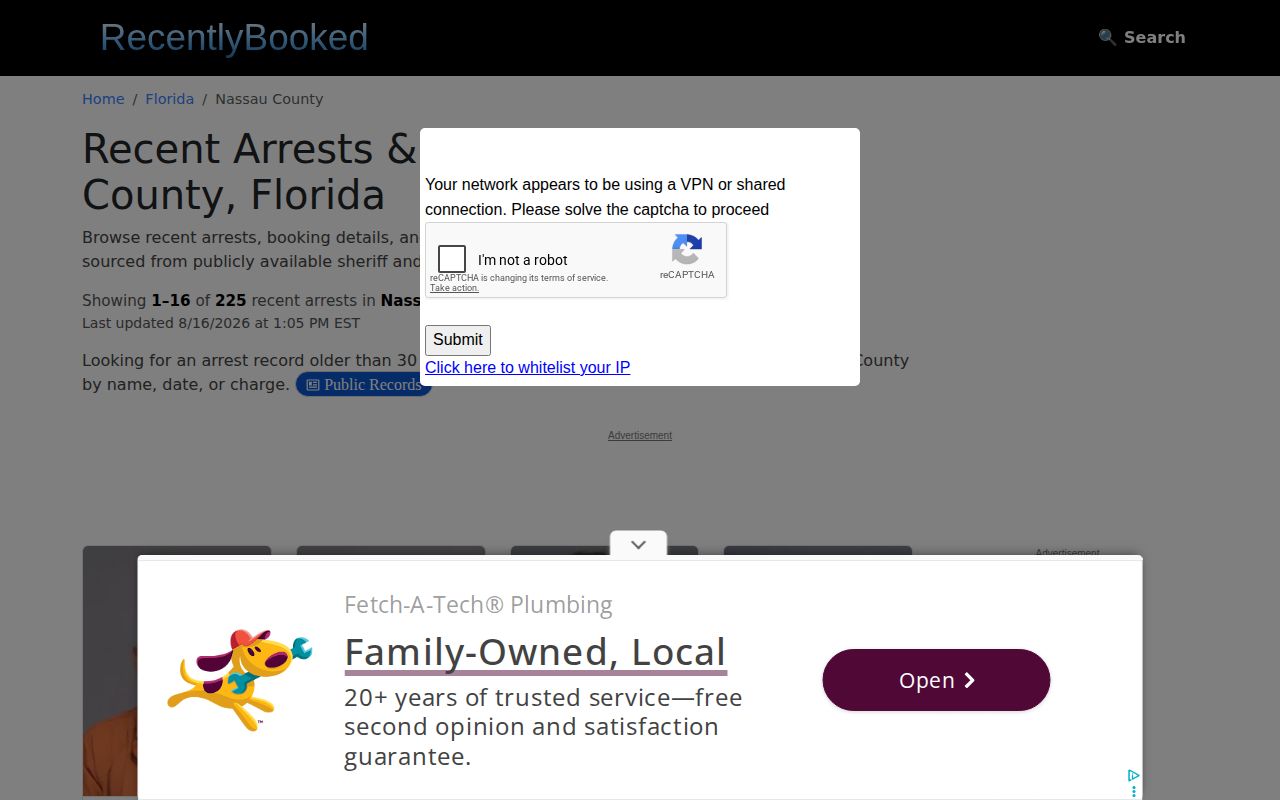
That capture shows the access path itself. Nothing more. It does not confirm present custody or accuracy. For anything that matters, NCSO and the Nassau County Clerk remain the controlling sources.
Nassau Arrest Feed Limits
Nassau County has no verified official feed of 24-hour, 48-hour, 72-hour, weekly, or released bookings. Filtering the live roster by today's date misses anyone released right after booking. So calling that filtered list "all arrests today" would simply be wrong.
For a bounded date range, ask NCSO Records whether an electronic booking log exists and can be released. Name your start and end dates and the fields you need. Wide extractions may take staff time or redaction. Local papers and the five commercial sections have gaps of their own, so none can stand in for an official feed.
Match the source to the question. Press releases cover selected agency events. The live roster answers who is in custody now. A booking record documents intake, and the Clerk docket tracks the prosecution. Newspapers add reporting, while unofficial services can surface a name. Each tool has its lane.
When you make a match, keep copies of the full name, approximate arrest date, arresting agency, and court case number. These identifiers are not interchangeable. A subject number belongs to the jail's person record. A booking number marks one intake episode. A court case number marks the prosecution. One person can have several bookings, and one arrest can spawn multiple counts or court records. Mixing identifiers is the most common cause of false matches.
An empty roster row does not mean the news story was false. Intake may still be processing. The person may already be released, or the article may cover an older event. NCSO Records handles past booking material, the arresting agency holds its incident report, and the Clerk shows the public case history. Date every result, because custody and court status shift over time.
Note: Released people vanish from the live NCSO roster even when their booking date falls inside the range you selected.